


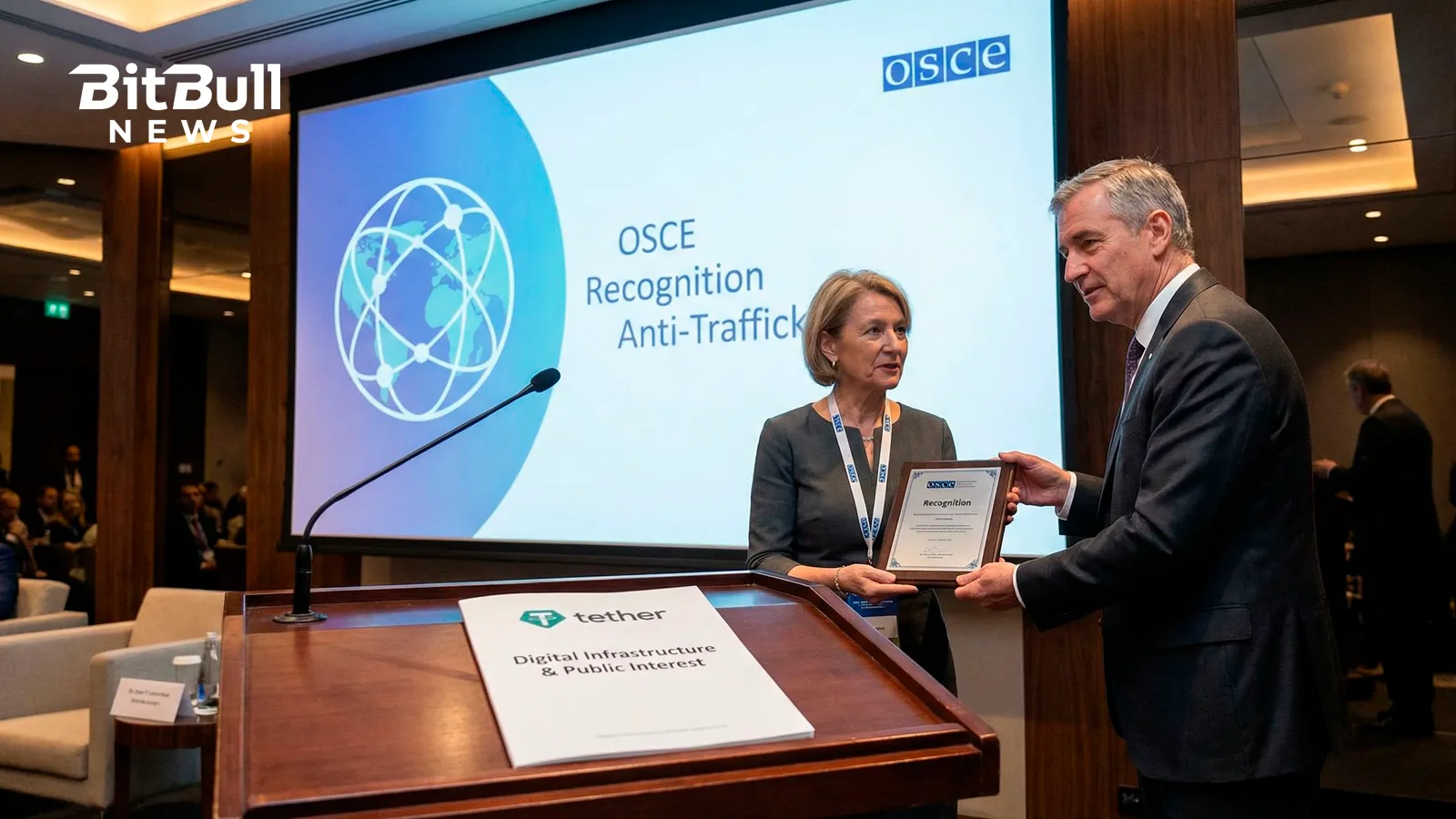
Tether says it has been recognized by the OSCE for supporting global efforts to combat human trafficking, but the more precise story is slightly narrower and more important. A new OSCE report on human trafficking investigations involving virtual assets explicitly thanks Tether’s compliance team for helping draft and analyze data for the guidance, placing a major stablecoin issuer directly inside a real law-enforcement policy document rather than on the sidelines of the discussion.
That matters because the OSCE report is not about crypto branding or corporate social responsibility. It is about how virtual assets are being used in trafficking-linked crime, including cyber-scam compounds and child sexual exploitation, and how law enforcement can work with blockchain analytics firms, exchanges, and stablecoin issuers to detect, freeze and recover illicit funds more effectively.
This was not an award — it was a policy-level acknowledgment
The strongest fact in the story is on page 8 of the OSCE report’s acknowledgements section. The Office of the Special Representative and Co-ordinator for Combating Trafficking in Human Beings thanks the Tether compliance team, along with named staff, for their collaboration in drafting and analyzing data and for contributing expert input to the guidance document. That is a real acknowledgment, but it is not the same thing as a formal award or endorsement of Tether as a company.
That distinction matters because the news angle is stronger when framed correctly. The OSCE is effectively signaling that stablecoin issuers now have an operational role in serious financial-crime and trafficking investigations, especially when they can freeze tokens, support tracing efforts, and coordinate with law enforcement across borders. That is an analytical conclusion drawn from the report’s examples and guidance.
Why virtual assets showed up in a trafficking report at all
The OSCE report says cryptocurrencies now facilitate a range of trafficking-related activity, from payments tied to child sexual exploitation to the financing of cyber-enabled scam compounds where trafficking victims are forced into criminality. It adds that the speed, borderless nature and cross-jurisdictional movement of virtual assets make them attractive to criminal networks.
That is what gives the report real policy weight. It is not treating crypto misuse as an isolated money-laundering issue. It is placing virtual assets inside a broader trafficking economy, where recruitment scams, online exploitation, money muling, and scam compounds can all intersect with crypto payments and laundering flows.
Tether’s role in the report is about freezing and reissuing funds
The OSCE paper uses Tether as a concrete example of what a centralized stablecoin issuer can do that many other crypto actors cannot. The report says that, as of September 15, 2025, Tether had frozen more than $3.2 billion in relation to law-enforcement investigations, and it highlights a case in which Tether, OKX, Chainalysis and U.S. authorities helped freeze about $225 million in USDT linked to a money-laundering network associated with a Southeast Asian scam compound.
The report goes further and says Tether later collaborated with the U.S. Department of Justice to burn the frozen assets and voluntarily reissue them to wallets controlled by the DOJ. It also says stablecoin issuers can, in some cases, burn frozen funds and reissue them to victims or government agencies, which the paper frames as a meaningful deterrent and a potentially important recovery tool.
Tether’s own March 27 release updates some of those numbers. The company says it has now frozen about $4.2 billion in assets linked to illicit activity and has worked with more than 340 law-enforcement agencies across 65 countries. That figure is newer than the OSCE paper’s September 2025 snapshot, so the two numbers are not contradictory; they reflect different dates.
The report points to a bigger shift in crypto enforcement
The OSCE’s guidance repeatedly stresses public-private collaboration. It calls out law enforcement agencies, blockchain analytics services, financial institutions, VASPs and stablecoin issuers as part of the practical investigative response, and it recommends more structured coordination across those groups when trafficking cases involve virtual assets.
That makes this story bigger than Tether alone. The report effectively sketches a model in which centralized crypto infrastructure providers are no longer treated only as passive intermediaries. They are increasingly expected to provide traceability, respond to requests, coordinate freezes, and help recover funds when serious crimes touch the blockchain. That is an analytical reading of the report’s guidance and examples.
What the report still does not say
The OSCE document does not present a formal ranking of stablecoin issuers, does not endorse one company over another as a matter of policy, and does not claim that centralized stablecoins are a complete answer to trafficking-related crypto abuse. It is a guidance paper focused on investigative cooperation, typologies and recovery tools.
Why it matters for crypto
- It shows stablecoin issuers are becoming part of the real-world investigative stack in trafficking and scam-compound cases, not just passive infrastructure providers.
- It strengthens the argument that centralized stablecoins can offer law-enforcement tools — especially freezing, burning and reissuing — that do not exist in the same way across more decentralized assets.
- It suggests future regulatory pressure on major stablecoin issuers will increasingly focus on responsiveness, traceability and cross-border cooperation, not only reserve transparency. This is an analytical inference from the OSCE guidance.
- It also reinforces that crypto crime policy is moving beyond sanctions and fraud into broader human-trafficking and exploitation frameworks.
What to watch next
- Whether more international bodies start naming stablecoin issuers and other crypto firms directly in anti-trafficking and anti-exploitation guidance. This is an inference based on the OSCE report’s approach.
- Whether law-enforcement agencies push for faster and more standardized cooperation protocols with stablecoin issuers across jurisdictions.
- Whether the policy debate shifts toward the tradeoff between centralized enforcement tools and the broader decentralization ethos in crypto. This is an inference grounded in the Tether examples used by OSCE.
- Whether other stablecoin issuers face pressure to demonstrate comparable freezing, recovery and coordination capabilities in serious criminal cases. This is also an inference based on the report’s focus.