


Seven Chinese Financial Associations Declare RWA Tokenization Illegal


Content
Seven major Chinese financial industry associations jointly declared that real-world asset (RWA) tokenization is an illegal financial activity, just after reinforcing their ban on crypto trading.
According to a local report, the China Internet Finance Association, China Banking Association, China Securities Association, China Asset Management Association, China Futures Association, China Association of Listed Companies, and China Payment and Clearing Association issued the notice warning both domestic and international practitioners that RWA activities lack any legal basis for operation under Chinese law.
RWA: Financing Activity Subject to Securities Law
The joint notice explicitly defined real-world asset tokenization as “financing and trading activities through the issuance of tokens or other rights and debt instruments with token characteristics,” stating such operations carry “multiple risks, including the risk of fictitious assets, the risk of business failure, and the risk of speculation.“
Regulators emphasized that “my country’s financial regulatory authorities have not approved any real-world asset tokenization activities,” eliminating any possibility that projects could claim to be in regulatory exploration phases or awaiting registration approval.
This stance differs from that of counterparts such as Singapore, which leads the global ranking in 2025 for RWA adoption.
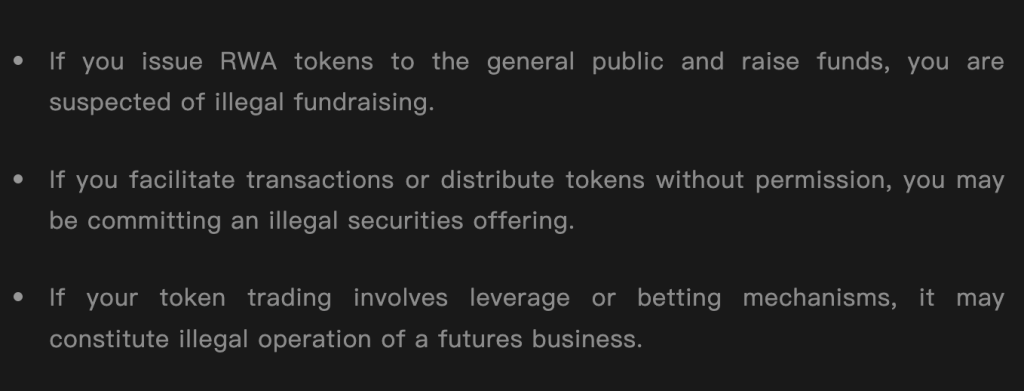
Officials particularly outlined three critical violations under existing Chinese law associated with RWA operations.
Joint Liability Under New Enforcement Framework
The notice specifically targeted not only project operators but the entire Web3 service ecosystem supporting RWA activities, stating that “domestic staff of relevant overseas virtual currency and real-world asset token service providers, as well as domestic institutions and individuals who knowingly or should have known that they are engaged in virtual currency-related businesses and still provide services to them, will be held accountable according to law.“
This “knowing or should have known” standard establishes a legal presumption of liability based on reasonable objective judgment rather than requiring proof of subjective intent, directly negating the common Web3 operational model of offshore company registration with mainland Chinese staff.
Attorney Honglin noted this means teams cannot escape accountability by claiming pure technology service provision or infrastructure support roles.
Project planners, technology outsourcing providers, marketing agents, influencer promoters, and payment interface providers all face potential legal consequences if they provide services to RWA projects targeting Chinese users.
The directive stated that even hiring a single operations person in China could expose ostensibly offshore projects to legal risks.
This enforcement approach effectively terminates the entire domestic Web3 service chain built around RWA within China, as supporting services lose viable business models alongside the prohibition on primary operations.
The crackdown follows frequent fraudulent activities operating under RWA branding, with the document noting that “criminals are taking advantage of this to promote related trading and speculation activities, using stablecoins, worthless coins (such as π coin), Real-World Asset (RWA) tokens, and ‘mining’ as a guise to carry out illegal fundraising, pyramid schemes, and other illegal activities.“

Joint Liability Under New Enforcement Framework
The notice specifically targeted not only project operators but the entire Web3 service ecosystem supporting RWA activities, stating that “domestic staff of relevant overseas virtual currency and real-world asset token service providers, as well as domestic institutions and individuals who knowingly or should have known that they are engaged in virtual currency-related businesses and still provide services to them, will be held accountable according to law.“
This “knowing or should have known” standard establishes a legal presumption of liability based on reasonable objective judgment rather than requiring proof of subjective intent, directly negating the common Web3 operational model of offshore company registration with mainland Chinese staff.
Attorney Honglin noted this means teams cannot escape accountability by claiming pure technology service provision or infrastructure support roles.
Project planners, technology outsourcing providers, marketing agents, influencer promoters, and payment interface providers all face potential legal consequences if they provide services to RWA projects targeting Chinese users.
The directive stated that even hiring a single operations person in China could expose ostensibly offshore projects to legal risks.
This enforcement approach effectively terminates the entire domestic Web3 service chain built around RWA within China, as supporting services lose viable business models alongside the prohibition on primary operations.
The crackdown follows frequent fraudulent activities operating under RWA branding, with the document noting that “criminals are taking advantage of this to promote related trading and speculation activities, using stablecoins, worthless coins (such as π coin), Real-World Asset (RWA) tokens, and ‘mining’ as a guise to carry out illegal fundraising, pyramid schemes, and other illegal activities.“